Roof Repair
Focused repairs to shingles, flashing, vents and roof penetrations that restore weather protection without replacing a roof that still has life in it.
Learn more
Roofing service
Water at a skylight is often not the skylight's fault, so the first job is working out where it is genuinely coming from.
The cause is identified before anything is quoted, because a replacement unit does not fix a leak that started somewhere else on the roof.
Flashing fault, failed seal, upslope leak and condensation all present the same way inside. Each has a different fix, and only one of them is the unit.
Where the detail has failed it is rebuilt as layered metal woven into the roofing courses, rather than re-caulked to buy another season.
Water entering at a chimney or wall above will travel down the sheathing and appear at the skylight. The slope upstream is checked before the unit is blamed.
Some units are past repair — fogged glazing and perished frames included. When that is the case you are told, rather than sold repeated repairs.
Skylights have a reputation for leaking that is only half deserved. The units themselves are generally well made. What fails is the junction between a factory-built object and a field-built roof — and, often enough, nothing fails at all and the water was never rain.
A wet patch at the head of a skylight shaft tells you almost nothing on its own. Four quite different faults produce it.
Failed flashing. The most common by a distance. Head flashing that pushes water sideways instead of over the courses below, step flashing that was sealed to the roofing rather than woven between the courses, or a flashing kit that never matched the roofing material in the first place.
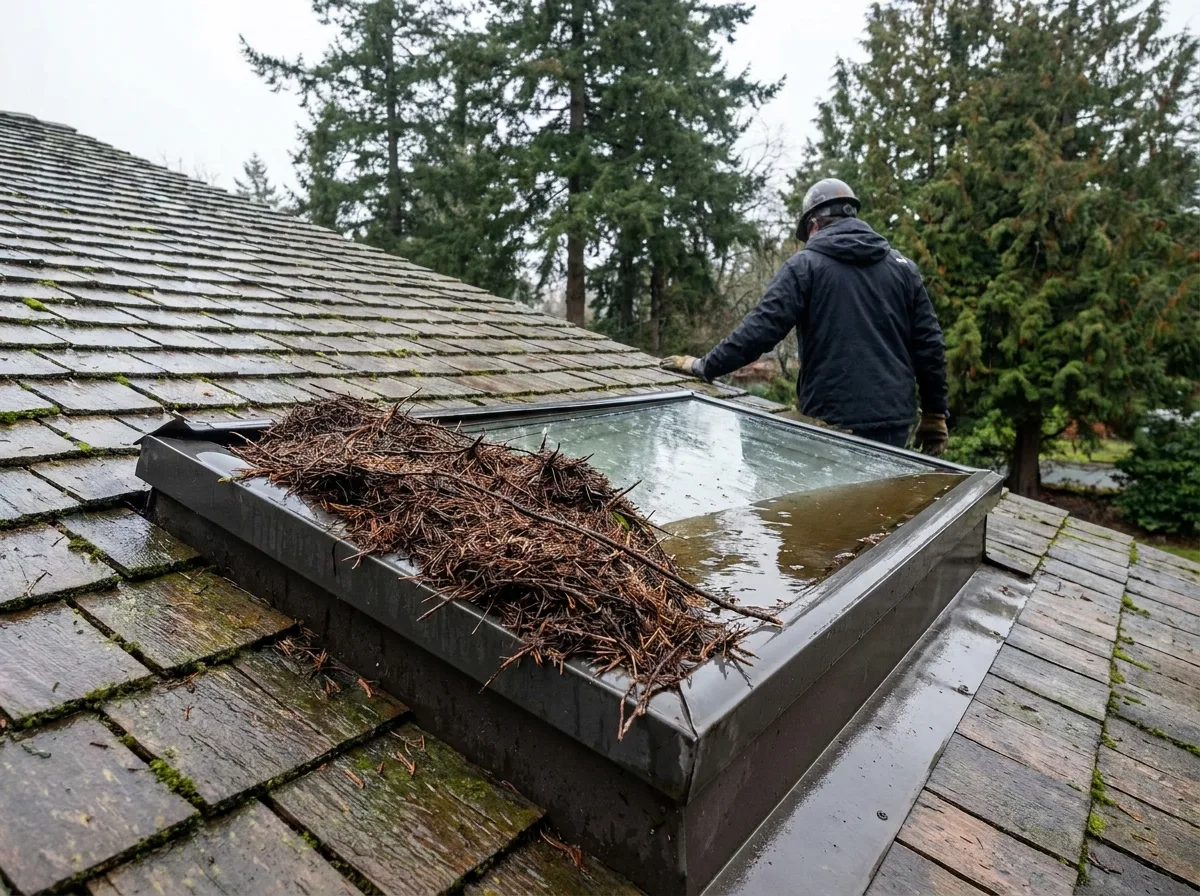
A debris dam. Skylights interrupt the roof plane, so they catch things. On lots overhung by Douglas fir and Garry oak, needles pile against the upslope side of the curb and hold water there permanently. That standing water finds its way under a detail that would otherwise have been fine.
A leak from further up. Water entering at a chimney, a wall junction or a lifted course above travels down the underside of the sheathing and emerges at the first obstruction it meets. A skylight shaft is a very effective obstruction. The unit is where the water appears, not where it entered.
Condensation. Glass is the coldest surface in the room. Moist indoor air condenses on it and on the frame, runs down and collects at the ceiling edge. The giveaway is that it happens in cold dry weather as readily as during rain, and shows evenly around the whole frame rather than at one corner.
Only the first two are repairs to the skylight. The third is a roof repair somewhere else entirely, and the fourth is a ventilation and humidity problem that no amount of roofing work will fix.
This matters because the fixes are not interchangeable and the wrong one is expensive. A new unit installed to cure a leak that originated at a chimney fifteen feet upslope will leak exactly as much as the old one did, and the homeowner has paid for a skylight they did not need.
So the assessment covers the unit and its glazing, the flashing on all four sides, the roofing courses above it, the state of the curb and deck, and the shaft below — along with the pattern of the staining, which usually tells the story before anything is lifted.
Where flashing has failed, the fix is to rebuild it as layered metal in correct sequence with the roofing: head flashing diverting water around the unit, step flashing woven one piece per course down both sides, sill flashing returning water onto the surface below. Every lap oriented so water crosses it rather than enters it.
The alternative is re-caulking, and it is worth being clear about what that buys. Sealant over a failed detail is a season, maybe two, in coastal sun. It is a legitimate short-term measure when a proper repair has to wait, but it should be described as what it is rather than sold as a repair.
Where a debris dam caused it, clearing above the unit is half the job and keeping it clear is the other half — which is why the area above a skylight belongs in routine roof maintenance rather than being revisited only when it leaks again.
Some skylights are genuinely past it. Fogging or haze between the panes means the sealed glazing unit has lost its seal and moisture is in the cavity; that pane is not serviceable in place. Perished or distorted frames, particularly on older acrylic domes that have spent decades in UV, are similar.
In those cases the honest answer is replacement rather than another repair, and the best time to do it is alongside roofing work if any is planned. A unit older than the roofing around it is worth dealing with while the roof is open.
Quotes are free and detailed. Crews are licensed, insured and covered by WorkSafeBC.
How it works
Four steps, in the order they actually happen.
We look at the unit, its flashing, the courses above it and the shaft below, and establish whether the pattern points to rain entry or to condensation.
You get the cause described plainly, with what is failing and why, before any figure is discussed and before any part is ordered.
The quote covers the actual repair — flashing rebuild, debris clearance, seal or unit replacement, shaft remediation — and says what is not included.
The detail is rebuilt in correct sequence with the roofing, the surrounding courses are made good, and the area is checked under water where appropriate.
Questions, answered
Most often the flashing rather than the glazing. Head flashing that sheds water sideways instead of over the courses below, step flashing sealed rather than woven into the roofing, or debris damming above the unit are the usual causes. Failed seals in the glazing unit itself are less common but do happen on older skylights.
Frequently, yes. A skylight is the coldest surface in a room, so humid indoor air condenses on the glass and frame and runs down into the shaft. Condensation appears in cold weather regardless of rain, shows evenly all around the frame rather than at one corner, and points to ventilation and humidity rather than to roofing.
Not necessarily. Water entering higher up the slope — at a chimney, a wall junction or a lifted course — runs down the underside of the sheathing and appears at the first obstruction it reaches, which is very often the top of a skylight shaft. The skylight is where the water shows, not where it got in. This is why the slope above gets checked.
No. Fogging or a permanent haze between the panes means the seal on the sealed glazing unit has failed and moisture is inside the cavity. The pane itself is not serviceable in place. Depending on the age and model, the glazing unit can sometimes be replaced within the existing frame; on older units it usually makes more sense to replace the whole skylight.
Repair is the usual answer when the unit is sound and the flashing has failed, which is the most common situation by some margin. Replacement makes sense when the frame has perished, the glazing seal has gone, the unit is significantly older than the roofing around it, or repeated properly executed repairs have not held. The assessment says which case you are in.
Related work
Focused repairs to shingles, flashing, vents and roof penetrations that restore weather protection without replacing a roof that still has life in it.
Investigation and repair of active or recurring roof leaks, tracing water intrusion back to where it genuinely enters the roof assembly.
New skylight installation and replacement of failed units, including the framing, curb and flashing detail that decide whether it stays watertight.
Tell us your name, how to reach you and what the roof is doing. We will come and look at it, then put the scope, the materials and the labour in writing before anything begins.
Mon–Fri 7:00am–5:00pm · Saturday by appointment
Thank you — your enquiry has come through. We will be in touch to arrange a site visit and go over the details. If the situation is urgent, call us directly rather than waiting on a reply.
(778) 562-5640Ready when you are
Book an assessment covering the unit, its flashing, the slope above and the shaft below.