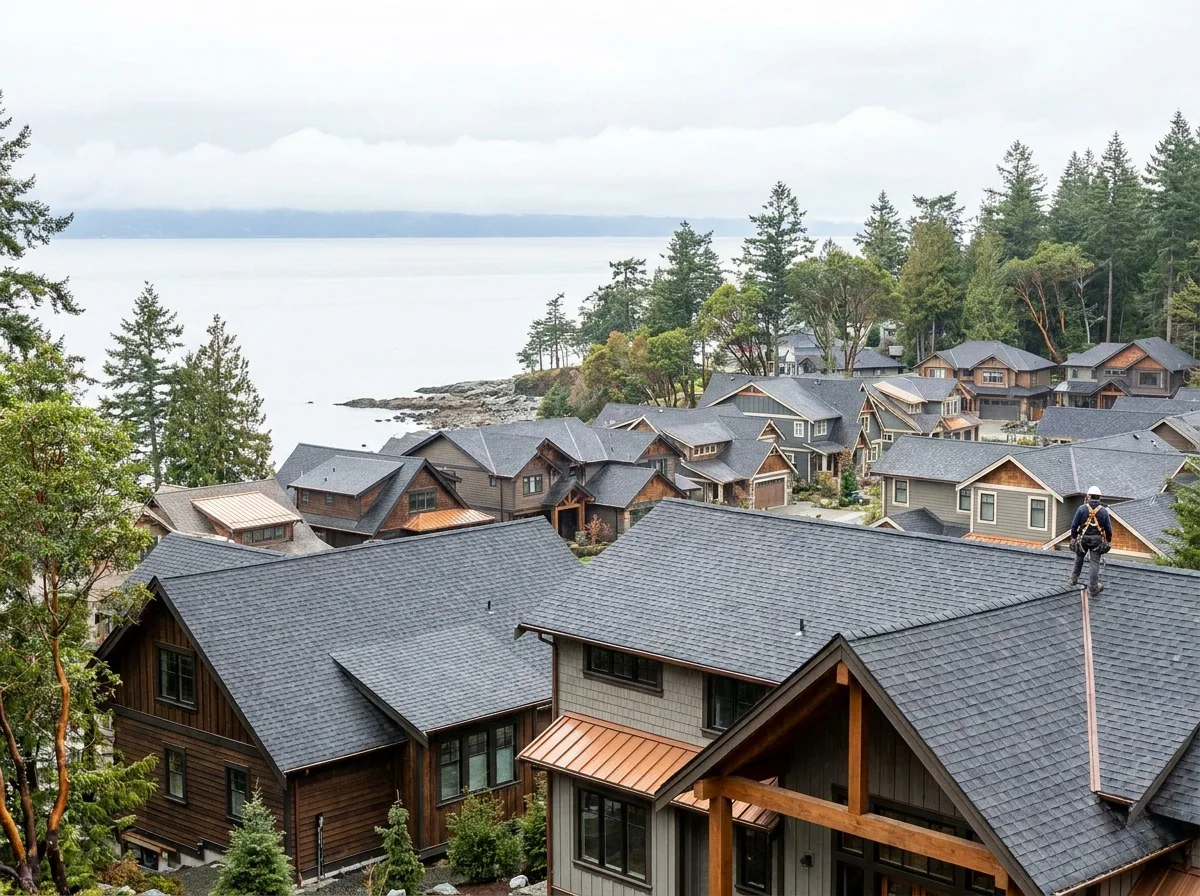
Roofing on the exposed edge of the Westshore
Colwood sits where the Westshore meets Juan de Fuca Strait, and that geography defines the roofing work here. Triangle Mountain rises directly above the water, the Lagoon area is open to the southwest, and Royal Bay is being built along the shoreline itself. Very little stands between those roofs and the weather coming in off the strait.
Wind is the governing condition
On a sheltered inland lot, a roof’s service life is mostly a story about ultraviolet exposure, debris and moisture. On the exposed Colwood slopes, wind uplift is the primary threat and it behaves in a specific way: it starts at an edge — a rake, an eave, a ridge cap, a poorly bonded starter course — gets under the covering, and progresses inward from there. Roofs rarely fail in the middle of a plane.
That is why the edges get the attention. Fastener placement, starter course installation, ridge and hip attachment and rake detailing are where an exposed roof is won or lost, and they are the parts of the specification worth reading carefully.
The new-build reality at Royal Bay
Royal Bay has added an enormous number of homes in a short span, which means thousands of roofs of nearly identical age. Those roofs are not near end of life, so the work there is different: diagnosing ventilation that was undersized for the roof design, correcting flashing at walls, skylights and penetrations that was rushed during a fast build cycle, and repairing storm damage while the materials are still within their warranty period.
Owners are often surprised to be dealing with a roof problem on a house barely out of its first decade. The explanation is almost always a detail rather than a material.
Older Colwood is a different job
The established streets around Colwood Corners hold modest postwar houses, frequently with additions, mismatched pitches and multiple roofing layers accumulated over the years. Those are genuine end-of-life replacements, and the scope depends heavily on what is found when the layers come off — particularly the condition of the decking beneath them.
When the weather does damage
Storm damage does not schedule itself. Get in touch by phone, email or the form and we will get back to you as quickly as we can, because the sequence matters: stop the water entering, make the structure safe, then assess and quote the permanent repair in daylight rather than improvising a fix in the dark.
Capital Roofing Victoria is licensed and insured, and every crew on your property is covered by WorkSafeBC.