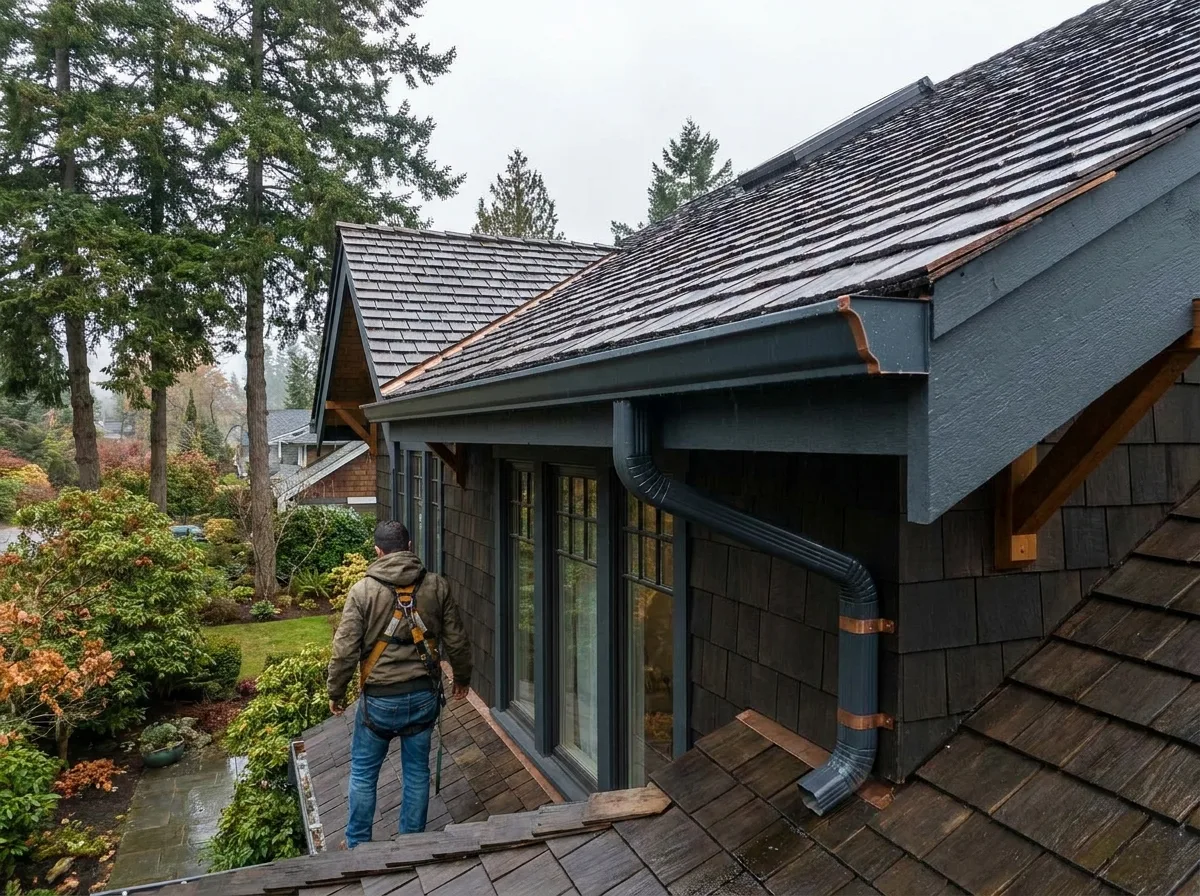
Roof Replacement
Complete tear-off and replacement for roofs at the end of their service life. Every layer is inspected and rebuilt, not just the visible surface.
Learn more
Roofing service
Gutters are the drainage half of your roof, and undersized or badly laid out ones cause damage the roofing never can.
Gutters planned as part of the roof and drainage system, with layout and capacity set by the roof area they serve rather than by habit.
Capacity is set by the roof area feeding each run and by the intensity of our winter storms, not by whatever profile is on the truck.
Outlet placement and count decide whether a gutter carries its load or overflows at the corners. Layout is worked out before anything is hung.
Fascia condition, drip edge and the roof-to-gutter relationship are checked while access is available, so water gets into the gutter rather than behind it.
Profile, capacity, downpipe count, hanger spacing and any fascia work are written out before installation, with no vague allowances.
Half the work of keeping a building dry happens after the water leaves the roof. Gutters catch it, downpipes carry it, and the discharge point decides whether it ends up in the storm drain or in the soil against your foundation.
The gutter on a house is frequently the profile the last installer had on the truck rather than the size the roof requires. That works fine through a light shower and fails predictably during the sustained downpours that arrive with our October to March rainfall, when water sheets over the front edge and lands where the gutter was meant to prevent it landing.
Capacity is a function of three things: how much roof drains into the run, how steep that roof is, and how many downpipes the run has. A long single run serving a large steep slope with one outlet at the far end will overflow no matter what profile is used.
Straight down the wall, behind the fascia, or into the soil at the base of the foundation. In a climate with long wet spells, that repeatedly saturated ground translates into damp crawlspaces, wet basements and eroded landscaping. Water running behind the gutter rots fascia and soffit, which then compromises the roof edge and, on many homes, the attic intake ventilation that runs through the soffit.
Where the downpipes go matters more than which gutter profile you buy. Outlets belong at the low points, runs need consistent fall toward them, and long elevations usually need more than one. Corners and valleys need particular thought, because a valley concentrates the water from two slopes into a single point on the gutter below.
The most efficient time to install new gutters is alongside a roof replacement. Access is already in place, the roof edge is exposed so drip edge can be set to deliver water into the gutter rather than behind it, and any rotted fascia is visible and can be dealt with while it is open.
On the many Greater Victoria lots overhung by Douglas fir and Garry oak, debris load is the governing factor. Needles are the difficult case, small enough to pass most guards and dense enough to pack solid at the outlets. Larger downpipe sizing, accessible cleanouts and realistic expectations about guards all help more than any single product claim.
A measured layout, a specified profile and downpipe count, and a written quote covering fascia work if the edge needs attention. Crews are licensed, insured and covered by WorkSafeBC.
How it works
Four steps, in the order they actually happen.
Each roof plane is measured and matched to the gutter run it drains into, which determines profile size, slope and how many downpipes are needed.
Fascia, soffit and drip edge are inspected for rot and correct detailing, since new gutters fastened to soft fascia will not stay where you put them.
Runs are hung with proper fall to the outlets, hangers are spaced for wind and water load, and downpipes are fitted and secured to the wall.
The system is water tested for fall and leaks, and discharge is directed away from the foundation rather than dumped at the base of the wall.
Questions, answered
It depends on the roof area draining into each run, the pitch of that roof and where the downpipes go. Steeper roofs deliver water to the gutter faster, so they need more capacity than the same area at a low pitch. Long runs with a single downpipe are a common cause of overflow here.
They help with leaves and reduce cleaning frequency, but no guard is maintenance free, and Douglas fir needles are the hardest debris to keep out because of their size and shape. Under heavy tree cover, guards usually change how often you clean rather than eliminating the job.
Aluminum is the common residential choice, being corrosion resistant, light and available in seamless runs formed on site. Steel is stronger and suits longer spans and heavier snow loads but needs its coating to stay intact near salt air. Both perform well when they are properly hung and drained.
There is a strong argument for it. Access is already set up, the roof edge is exposed so drip edge and fascia can be detailed correctly, and the new gutters go on without disturbing new roofing. Replacing them separately later means working around a roof that is already finished.
Well clear of the foundation, into a drain, a splash block set on grade that falls away from the house, or a rainwater system. Discharging at the base of a wall saturates the ground exactly where you least want it, and in a wet-winter climate that shows up as damp basements and crawlspaces.
Related work
Complete tear-off and replacement for roofs at the end of their service life. Every layer is inspected and rebuilt, not just the visible surface.
Repairs to leaking, sagging, loose, blocked or poorly draining gutters, downpipes and outlets across Greater Victoria.
Repair and replacement of rotted or damaged soffit and fascia, restoring the roof edge along with the ventilation and drainage that depend on it.
Tell us your name, how to reach you and what the roof is doing. We will come and look at it, then put the scope, the materials and the labour in writing before anything begins.
Mon–Fri 7:00am–5:00pm · Saturday by appointment
Thank you — your enquiry has come through. We will be in touch to arrange a site visit and go over the details. If the situation is urgent, call us directly rather than waiting on a reply.
(778) 562-5640Ready when you are
Book a measure-up and get a quote sized to the roof area your gutters actually serve.