Roof Repair
Focused repairs to shingles, flashing, vents and roof penetrations that restore weather protection without replacing a roof that still has life in it.
Learn more
Roofing service
A commercial roof has to be replaced around tenants, trading hours and rooftop equipment, not just around the weather.
Planning that accounts for how the building is used, how the roof is reached, what equipment sits on it and how to keep disruption to a minimum.
Access routes, staging areas, noise, odour and delivery timing are worked out before the crew arrives, so tenants and customers are not an afterthought.
On low-slope commercial roofs, drainage design decides everything. Drains, scuppers, slope and ponding areas are assessed as a system, not patched individually.
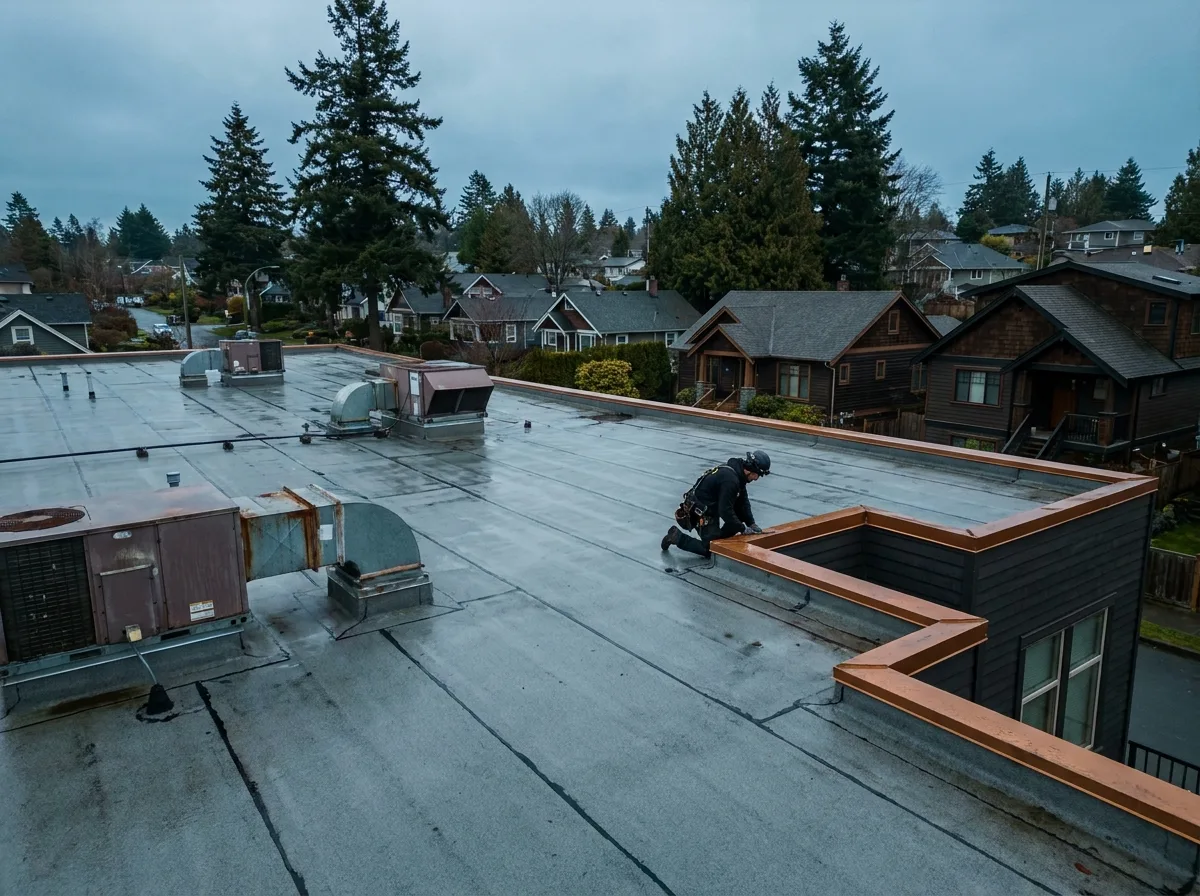
Rooftop units, curbs, ducting, conduit and vents are the leak points on most commercial roofs, and each gets detailed rather than sealed over.
Scope, system, flashings, disposal and phasing are set out in writing so property managers and owners can approve real numbers, not estimates.
A commercial roof is judged by different criteria than a house roof. It has to be replaced without closing the business underneath it, it carries mechanical equipment that has to keep running, and the person approving the work is usually accountable to owners, a strata council or a head office.
Membrane installation is a known quantity. The complexity sits around it: getting material onto the roof of a building with no side yard, staging on a downtown lot with no parking, keeping a fire exit clear, working around a restaurant’s service hours, managing odour and noise above occupied offices.
Those constraints have to be settled before pricing means anything. A proposal that ignores access and phasing will not survive contact with the building.
Much of Greater Victoria’s commercial stock is mid-century and flat-roofed, particularly through downtown and along the Douglas and Blanshard corridors. On a low-slope roof, water leaves only where the roof lets it, which makes drains, scuppers and slope the primary system rather than an accessory.
Ponding is the diagnostic. Water still sitting more than a day or two after rain means the drainage is not doing its job, whether from a blocked drain, a deflected deck or a slope that was never adequate. Under the region’s October to March rainfall, that standing water works on seams and flashings continuously.
Rooftop units, exhaust fans, ducting, conduit, gas lines and antenna mounts each punch through the assembly and each needs a curb or a properly detailed penetration. Every service call on that equipment is a chance for someone to walk the membrane, drop a tool or reseal something badly.
On a re-roof, the equipment question has to be answered early: what gets lifted, what gets recurbed, what has to keep operating throughout and who coordinates the mechanical trade.
Concentrated leaks at details usually mean repair. Broadly weathered membrane with seam failures across the field means replacement. Between those sits the overlay question, and it turns on what is already up there, how many layers exist, whether the deck can take the load and whether the insulation below is wet. Wet insulation under a new membrane guarantees the new roof underperforms.
Strata and managed buildings need a scope that stands up to review: what is being done, what was found, photographs of existing conditions and a phasing plan. That is standard practice here, not an extra. Crews are licensed, insured and carry WorkSafeBC coverage, and quotes are free and itemized.
How it works
Four steps, in the order they actually happen.
The full roof area is assessed for membrane condition, drainage performance, ponding, flashing details, curbs and every penetration through the deck.
You get a written proposal with the system, the detailing and, where the building must keep operating, a sequence that takes it in sections.
Access, staging, material handling and site protection are arranged before work starts, with WorkSafeBC requirements built into the plan rather than added to it.
The system is installed section by section with each area made watertight before the day ends, and the finished roof is walked with you.
Questions, answered
Usually, and it is normally the requirement. Work is phased across the roof so only part of the building is affected at a time, access and staging are kept away from public entrances, and the noisiest stages are scheduled around trading or working hours where possible.
Most commercial buildings here are low-slope and take a membrane system, with single-ply and modified bitumen the common families. Metal appears on newer light-industrial construction. Selection depends on the deck, the existing assembly, rooftop equipment, foot traffic and how long the owner intends to hold the building.
Look at how widely the failures are distributed. Leaks concentrated at a few curbs, drains or flashing details generally point to repair. Membrane that is broadly weathered, splitting at seams across the field or holding water in multiple ponding areas is telling you the system is at its end.
Details rather than field membrane. Rooftop unit curbs, drain assemblies, pipe and conduit penetrations, parapet and wall flashings, and seam failures at laps. On the Douglas and Blanshard corridors, blocked drains during heavy winter rain are another regular cause, since a flat roof holds what it cannot drain.
Yes. Those projects usually need more documentation than a single-owner building, including a clear written scope suitable for council or ownership approval, photographic records of conditions found, and phasing that works around residents and their parking and access.
Related work
Focused repairs to shingles, flashing, vents and roof penetrations that restore weather protection without replacing a roof that still has life in it.
Scheduled preventive maintenance that finds and corrects minor roofing faults before they turn into leaks, rot and replacement bills.
Installation, repair and replacement of flat and low-slope roofing systems for homes and commercial buildings across Greater Victoria.
Tell us your name, how to reach you and what the roof is doing. We will come and look at it, then put the scope, the materials and the labour in writing before anything begins.
Mon–Fri 7:00am–5:00pm · Saturday by appointment
Thank you — your enquiry has come through. We will be in touch to arrange a site visit and go over the details. If the situation is urgent, call us directly rather than waiting on a reply.
(778) 562-5640Ready when you are
Book a roof survey and receive an itemized written proposal for owners or council.