Roof Replacement
Complete tear-off and replacement for roofs at the end of their service life. Every layer is inspected and rebuilt, not just the visible surface.
Learn more
Roofing service
A proper inspection tells you what your roof needs now, what it will need soon, and what can safely be left alone.
Condition-focused inspections that separate immediate repair needs from problems still developing, so you can budget rather than react.
Issues are separated into what needs doing now and what is worth watching, so you can spread work over seasons rather than face one surprise bill.
Where the attic is accessible, the sheathing underside is checked for staining, rot and condensation, which often reveals problems the surface hides.
Gutters, valleys, downpipes, intake and exhaust are assessed as part of the roof rather than treated as somebody else's category.
If the roof is sound, the report says so. An inspection that only ever concludes replacement is a sales call, not an assessment.
Most people find out about their roof in the worst possible order: the ceiling stains, then the diagnosis, then the bill. An inspection reverses that sequence. It converts an unknown into a schedule.
Two questions, mainly. How much service life is left in the roofing, and is anything failing right now that will let water in this winter. Those are different questions, and a roof can easily be ten years from replacement while carrying a flashing detail that fails next month.
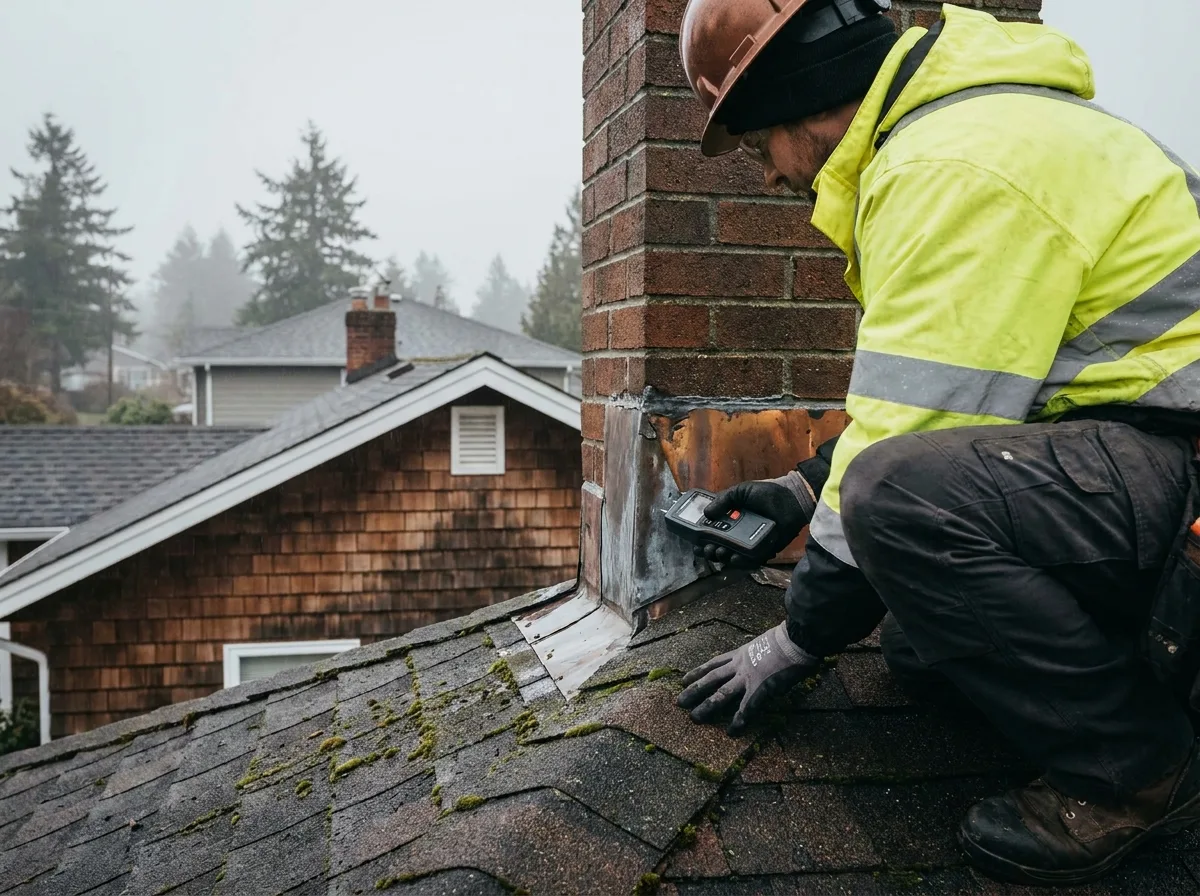
Answering them well means looking at more than the shingles. The components that fail earliest are the ones that interrupt the roof plane: chimney counter flashing, step flashing at walls and dormers, valley metal, plumbing vent boots, skylight head flashing and the roof edge.
The underside of the sheathing is a written record. Old dry stains show past leaks that were fixed. Rust trails at nail points show water passing through. Diffuse dampness, dark mould and frost in cold weather point to condensation rather than rain, which is a ventilation problem and no amount of roofing will resolve it.
Moss on north-facing slopes is endemic here rather than occasional. Left alone, it lifts shingle edges, holds water against the mat and shortens roof life measurably, so its extent and how it is being managed matters.
Debris load is the other regional constant. Douglas fir needles and Garry oak leaves pack into valleys and behind gutters, and a valley that cannot drain will push water sideways under the roofing during heavy October-to-March rain.
Heritage properties add their own considerations. Steep pitches, complex rooflines with many valleys, original board decking rather than plywood, and often several layers of old roofing stacked up. All of that changes both the inspection method and what a future replacement will involve.
Before a purchase, an inspection gives you remaining service life and likely near-term costs, which is far more specific than the paragraph a general home inspection devotes to the roof. Before a sale, it lets you fix small things cheaply instead of negotiating against a buyer’s worst assumptions.
For owners simply staying put, an annual look in early autumn catches the small failures while they are still small, before the wet season tests every one of them.
A straight account of condition, findings sorted by priority, and a free detailed quote for anything you choose to act on. If the roof is fine, that is what you will be told. Crews are licensed, insured and WorkSafeBC covered.
How it works
Four steps, in the order they actually happen.
Every accessible slope is examined for material condition, fastener performance, moss growth, previous repairs and debris accumulation.
Flashings, valleys, chimneys, skylights, vent boots and the roof edge get individual attention, since these are where most failures begin.
Where there is attic access, the sheathing, framing, insulation and ventilation path are checked for moisture, staining and airflow blockages.
You get a clear account of the roof's condition with priorities, plus a written quote for anything you decide to have done.
Questions, answered
Once a year is a reasonable rhythm in this climate, ideally in early autumn before the wet season sets in. Also worth doing after a significant windstorm, after any tree work near the house, and before buying or selling a property.
Roofing material condition and remaining service life, all flashings and penetrations, valleys, ridge and edge detailing, fastener performance, moss and debris load, gutters and drainage, and the ventilation system. Where the attic can be reached, the sheathing underside and insulation are checked for moisture.
Much can be assessed from ladders, from the ground with optics and from inside the attic, and some roofs should not be walked at all. Brittle old shingles, mossy north slopes, steep heritage pitches and cedar shake past its life are all cases where walking causes damage or risks a fall.
It is worth doing, particularly on the pre-1940 housing stock in Fairfield, James Bay, Rockland and Oak Bay. General home inspections cover the roof briefly and from a distance. A roofing-specific assessment gives you remaining service life and likely costs, which is negotiating information.
Granules collecting in gutters, shingles curling or losing their seal, daylight visible in the attic, sagging rooflines, damp or musty attic air, thick moss on north-facing slopes, and any new ceiling or wall staining. Also watch for gutters overflowing during ordinary rain.
Related work
Complete tear-off and replacement for roofs at the end of their service life. Every layer is inspected and rebuilt, not just the visible surface.
Focused repairs to shingles, flashing, vents and roof penetrations that restore weather protection without replacing a roof that still has life in it.
Scheduled preventive maintenance that finds and corrects minor roofing faults before they turn into leaks, rot and replacement bills.
Tell us your name, how to reach you and what the roof is doing. We will come and look at it, then put the scope, the materials and the labour in writing before anything begins.
Mon–Fri 7:00am–5:00pm · Saturday by appointment
Thank you — your enquiry has come through. We will be in touch to arrange a site visit and go over the details. If the situation is urgent, call us directly rather than waiting on a reply.
(778) 562-5640Ready when you are
Book an inspection and get a clear read on condition, priorities and timing.