Skip to content

Oak Bay, BC

Oak Bay Roofing for Character Homes

Tudor revival gables, Arts and Crafts eaves and Uplands estate rooflines demand work that respects how the house was built.

Roofing in Oak Bay

Roofing for Oak Bay's heritage housing stock — multi-plane rooflines, original cedar, heavy flashing detail and mature-canopy moss pressure.

  • Rooflines with more transitions than field

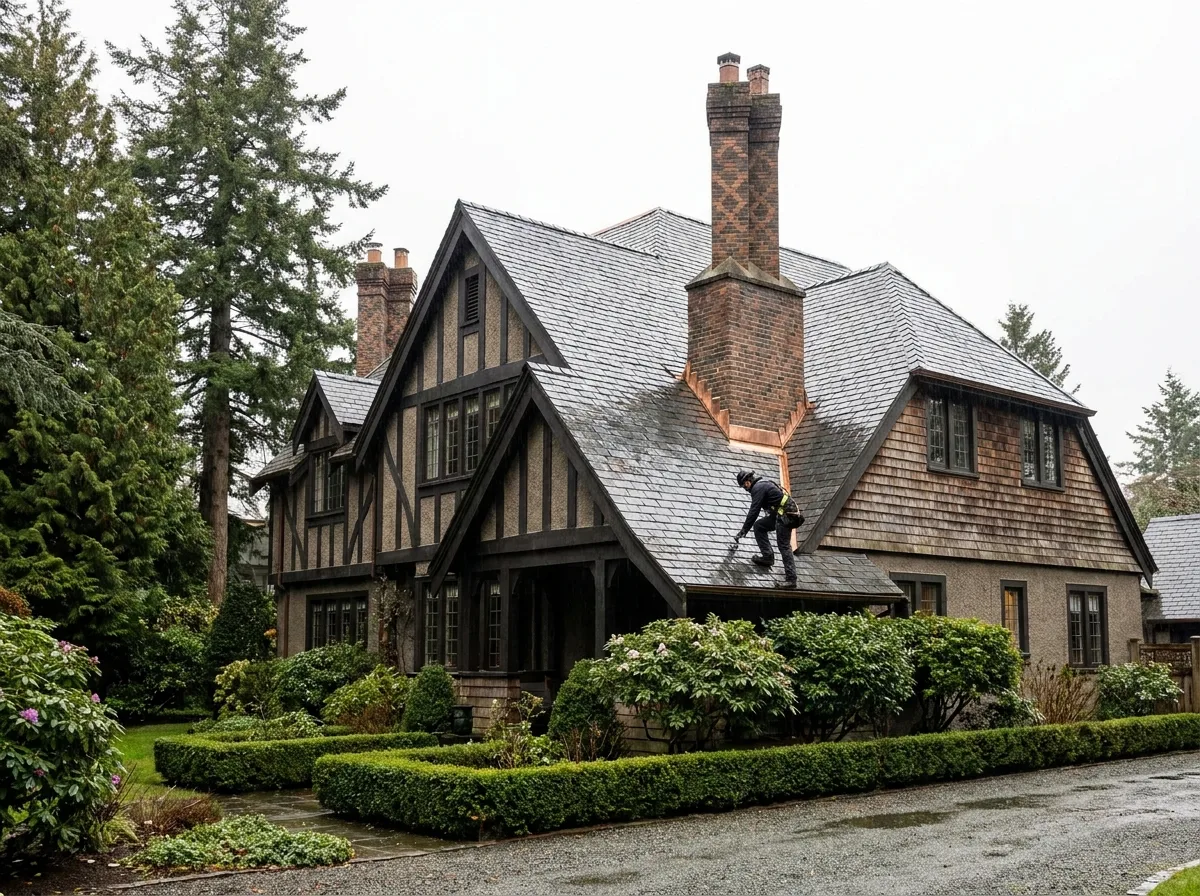
    Oak Bay's Tudor revival and Arts and Crafts houses were designed around the roof — steep pitches, swept eaves, multiple intersecting planes, deep overhangs and prominent chimneys. On a house like that, more of the roof is edge, valley and flashing than open shingle field. The work concentrates in the details, and so does the risk of failure.

  • Original cedar, slate and clay tile

    A meaningful number of Oak Bay properties still carry the material they were built with, including cedar shake and, on some houses, slate or clay tile. Each behaves differently underfoot, fails differently and requires different fastening and flashing. Assessing what is actually up there — and whether it can be repaired rather than replaced — comes before any recommendation.

  • Appearance is part of the specification

    In Oak Bay the roof is a defining visual element of the house and the street. Profile, colour and shadow line matter as much as water shedding, and a replacement that performs well but reads wrong from the sidewalk is not a success. We treat the finished appearance as part of the scope, not an afterthought. The mature canopy over these streets adds a second constant: shaded planes stay damp for months, and moss lifts shingle edges and dams valleys if it is left to build.

Roofing Oak Bay’s heritage housing stock

Oak Bay contains some of the most architecturally deliberate housing in British Columbia. Tudor revival, Arts and Crafts and the grand estate homes of the Uplands were all designed with the roof as a central element rather than a cap on top of the walls. Steep pitches, swept eaves, deep overhangs, prominent brick chimneys and multiple intersecting planes are the norm here, not the exception.

Why these roofs take longer

On a typical modern gable roof, most of the surface is uninterrupted field and the crew moves quickly across it. On an Oak Bay character home, a large share of the roof is edge condition — valleys, hips, sidewall and headwall flashing, dormer cheeks, chimney counterflashing and tie-ins where a later addition meets original framing. Every one of those is hand work, and every one of them is a potential leak path if it is done to a generic detail rather than to what the house actually needs.

Original materials still in service

Plenty of Oak Bay roofs still carry the material they were built with. Cedar shake remains common, and slate and clay tile survive on a number of properties. Each behaves differently: slate rarely fails before its fasteners and flashings do, cedar fails from the exposed edge inward, and tile is unforgiving of foot traffic. Getting the assessment right determines whether a repair is realistic or a replacement is the honest answer.

Cedar conversion, done properly

Where cedar has reached the end of its service life, converting to an asphalt or metal system means more than swapping the covering. Skip sheathing must be overlaid with a continuous deck, ventilation reassessed, and every flashing detail rebuilt for a system that sheds water differently than shakes do. We itemise that scope so the additional work is visible in the quote instead of appearing later as a change.

The look matters

Oak Bay streets are legible partly because their rooflines are consistent. A replacement that performs well but reads wrong — the wrong profile, the wrong colour depth, the wrong shadow at the eave — has failed at something the owner will notice every day. Appearance is part of what we quote.

Moss under a mature canopy

Deep tree cover, shaded planes and a long wet season keep Oak Bay roofs damp for months. Moss lifts shingle edges, dams valleys and holds water against surfaces that should be draining. Clearing it on a schedule is one of the cheapest things an owner can do for an expensive roof.

Capital Roofing Victoria is licensed and insured, and every crew carries WorkSafeBC coverage. For an emergency leak in Oak Bay, call, email or send the form and we will get back to you as quickly as we can.
Most requested here

What Oak Bay roofs need most

All services

Roof Replacement

Complete tear-off and replacement for roofs at the end of their service life. Every layer is inspected and rebuilt, not just the visible surface.

Scope is set after the roof is actually assessed, so the recommendation reflects the condition of your decking, flashing and ventilation rather than a standard package.

Explore this service

Roof Repair

Focused repairs to shingles, flashing, vents and roof penetrations that restore weather protection without replacing a roof that still has life in it.

Learn more

Cedar Shake Conversion

Replacing aging cedar shake roofing with a modern system, including the skip-sheathing and decking work these conversions almost always require.

Learn more

Soffit & Fascia

Repair and replacement of rotted or damaged soffit and fascia, restoring the roof edge along with the ventilation and drainage that depend on it.

Learn more

Skylight Repair

Diagnosis and repair of leaking skylights — flashing failures, debris damming, failed seals, and the condensation that gets mistaken for all three.

Learn more

Moss Removal

Careful moss removal that protects roofing material while clearing the growth that shortens roof life on our damp north-facing slopes.

Learn more

Questions, answered

Roofing questions from Oak Bay

  • That is the goal on most Oak Bay houses. Profile, colour and the shadow line at the eaves all affect how the roof reads from the street, and we discuss those choices before the quote is finalised. Where a like-for-like material is not practical, we will show you the closest performing alternative and explain the visual difference honestly.

  • Often it can, depending on the condition of the slate itself, the fasteners and the underlying deck. Slate frequently outlasts everything holding it up, so the failure is usually in the nails, the flashing or the sheathing rather than the tile. We assess those separately before recommending replacement.

  • Because the architecture demands it. Dormers, cross-gables, wall tie-ins, deep valleys and multiple chimneys each need their own flashing detail, and older houses often have all of them on one roof. That complexity is why an Oak Bay roof takes longer than a comparable square footage on a simple modern gable.

  • Repeated surface patching usually means the original counterflashing was never properly let into the masonry, so water travels behind the repair instead of over it. The fix is to rebuild the detail correctly rather than add another layer of sealant. On old brick chimneys, the masonry condition itself needs checking at the same time.

  • Yes, and on houses with deep Arts and Crafts overhangs it often makes sense to. Fascia rot and failing soffit venting are usually revealed once the eave is opened up during tear-off, and dealing with them while the edge is exposed is far less disruptive than returning later.

Ready when you are

A roof quote that respects the house

Free, detailed and itemised — materials, scope and appearance discussed before work starts.