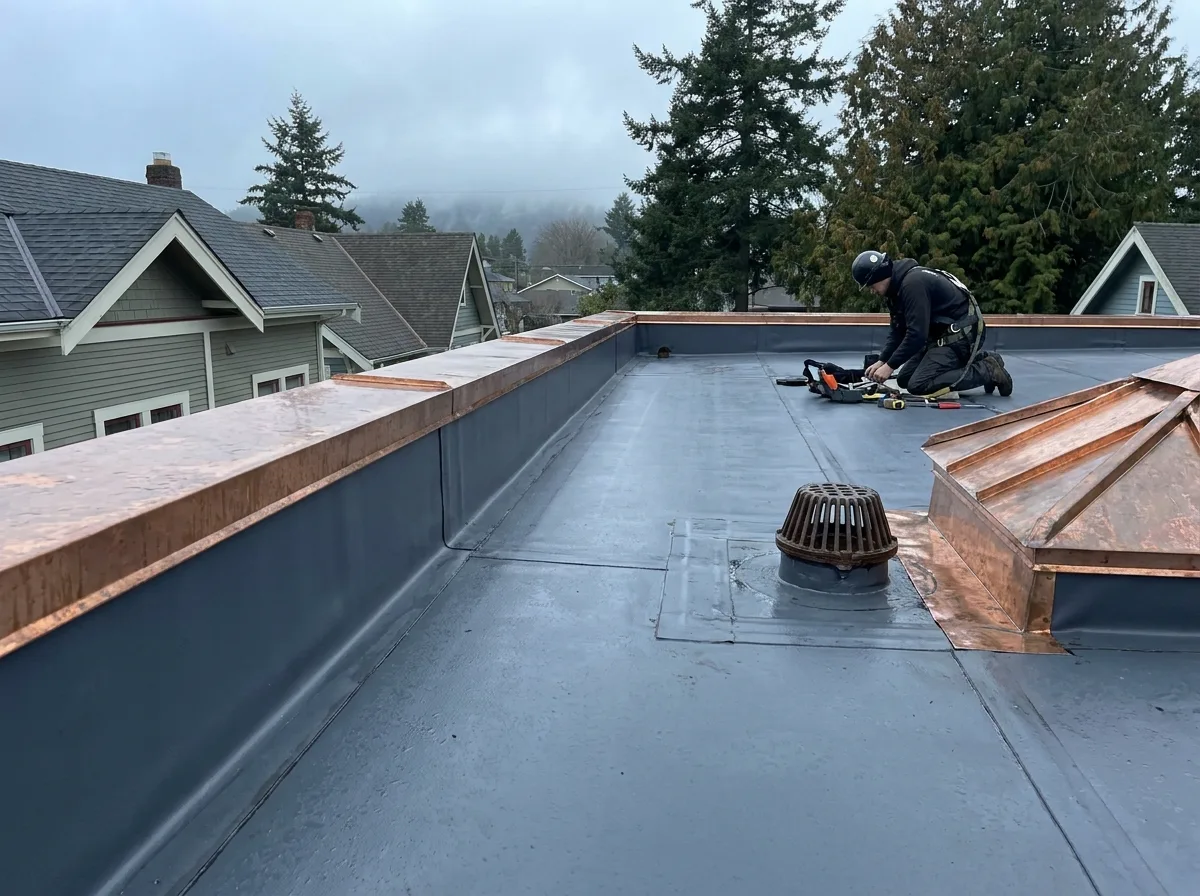
Roof Replacement
Complete tear-off and replacement for roofs at the end of their service life. Every layer is inspected and rebuilt, not just the visible surface.
Learn more
Roofing service
A flat roof only stays dry if the water can leave, which makes drainage and detailing the whole job.
Attention concentrated where low-slope roofs actually fail: drainage, membrane seams, penetrations, parapets and the transitions between them.
Slope, drains, scuppers and overflow are assessed before a system is chosen, because a perfectly installed membrane over bad drainage still holds water.
Laps, edge terminations, parapet flashings and corner details are where low-slope roofs fail. They get the time they deserve rather than the time left over.
Vents, pipes, conduit, equipment curbs and skylights are each flashed as a designed detail instead of being sealed in and hoped for.
The system, the insulation, the flashings and any decking work are written out before the job, so you can see what you are actually paying for.
Flat roofs are not flat. Or they should not be. Every low-slope roof is built with just enough fall to move water toward a drain or a scupper, and when that fall is compromised by a deflected deck, a settled section or insulation that was never tapered properly, the roof stops draining and starts holding.
Under the region’s October to March rainfall, a low-slope roof is wet for weeks at a stretch. That is fine, provided the water leaves. Ponding that persists a day or two after the rain stops is the single most useful symptom on a flat roof, because it points at drainage rather than at the membrane.
Water that sits works continuously on seams, degrades membrane faster under summer UV, adds real weight to the structure and finds any lap or termination that is less than perfect. Fixing the leak without fixing the ponding means doing it again.
Seams and laps. The membrane field is rarely the problem. Where two sheets join, and where the membrane terminates, is where age shows.
Penetrations. Plumbing vents, conduit, equipment curbs, skylight kerbs and antenna mounts each break the plane. Each needs a flashed detail with proper height above the water line, not a sealed collar at deck level.
Parapets and edges. Wall junctions, parapet caps and edge metal take wind loading and thermal movement. On the mid-century buildings around downtown, original parapet detailing is a frequent source of long-running leaks.
Drains and scuppers. Blocked by debris, undersized for the area, or set slightly above the low point so the roof never fully empties.
Greater Victoria has a substantial stock of mid-century flat-roofed buildings, particularly downtown and along the Douglas and Blanshard corridors, alongside a growing number of residential flat roof sections on modern additions and covered decks.
The residential ones bring their own complication: a pitched roof above frequently drains onto a small membrane area below, concentrating a large volume of water into a detail that was often treated as an afterthought. Add Douglas fir needles washing down from the slope above and blocking the outlet, and the failure mode writes itself.
A localized failure at a curb or a lap is a repair. Broad weathering, splitting across the field and multiple ponding areas mean the system is finished. The overlay option in between depends entirely on what is underneath, and saturated insulation under a new membrane is a guaranteed disappointment. Opening a test area answers it honestly.
Quotes are free, detailed and itemized, and crews are licensed, insured and WorkSafeBC covered.
How it works
Four steps, in the order they actually happen.
We check membrane condition, seams, terminations and, critically, where water sits after rain and whether the drains and scuppers are performing.
You get a written recommendation covering the membrane, insulation and detailing, with the reasoning behind it explained in plain terms.
Failed material comes off, the deck is checked for rot and deflection, and any slope or insulation corrections are made before the membrane goes on.
The membrane, flashings and terminations are installed as one system, and drainage is checked so water leaves the roof where it is supposed to.
Roof condition
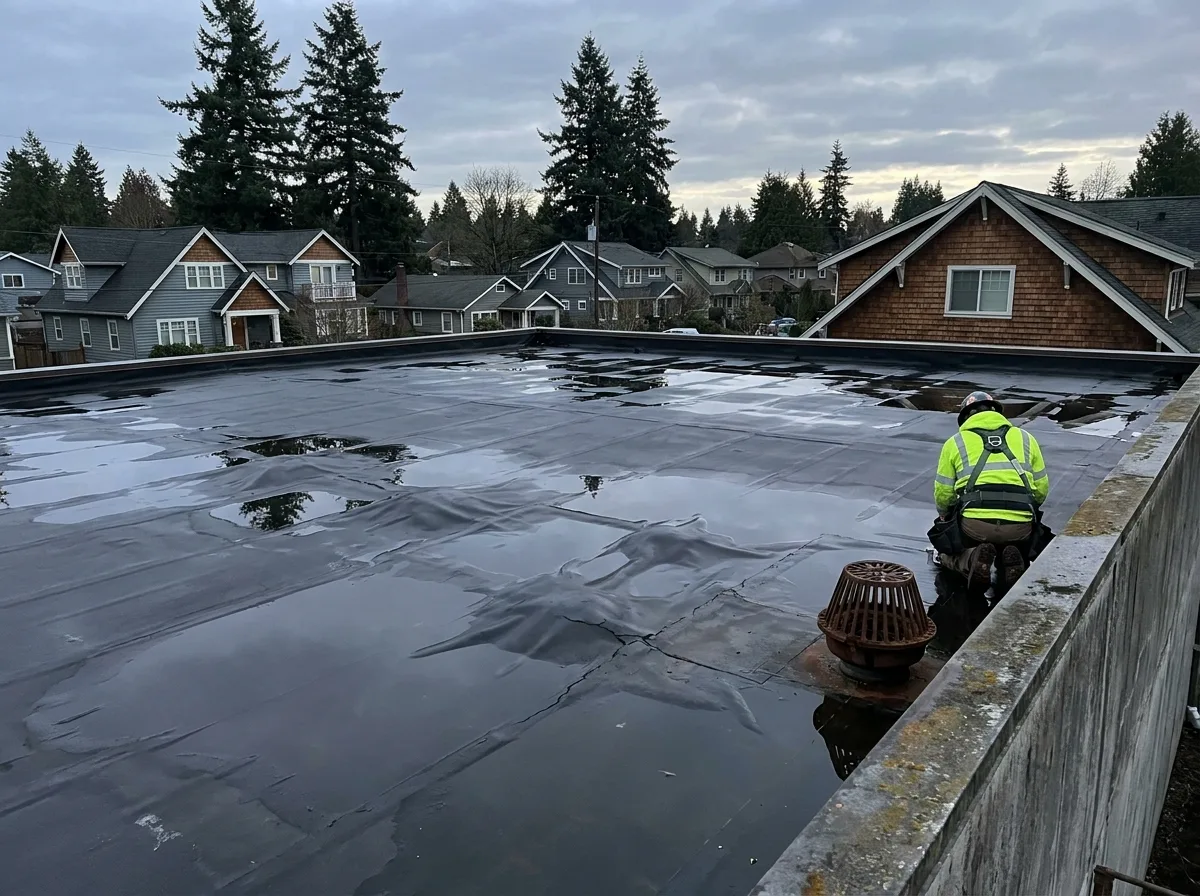
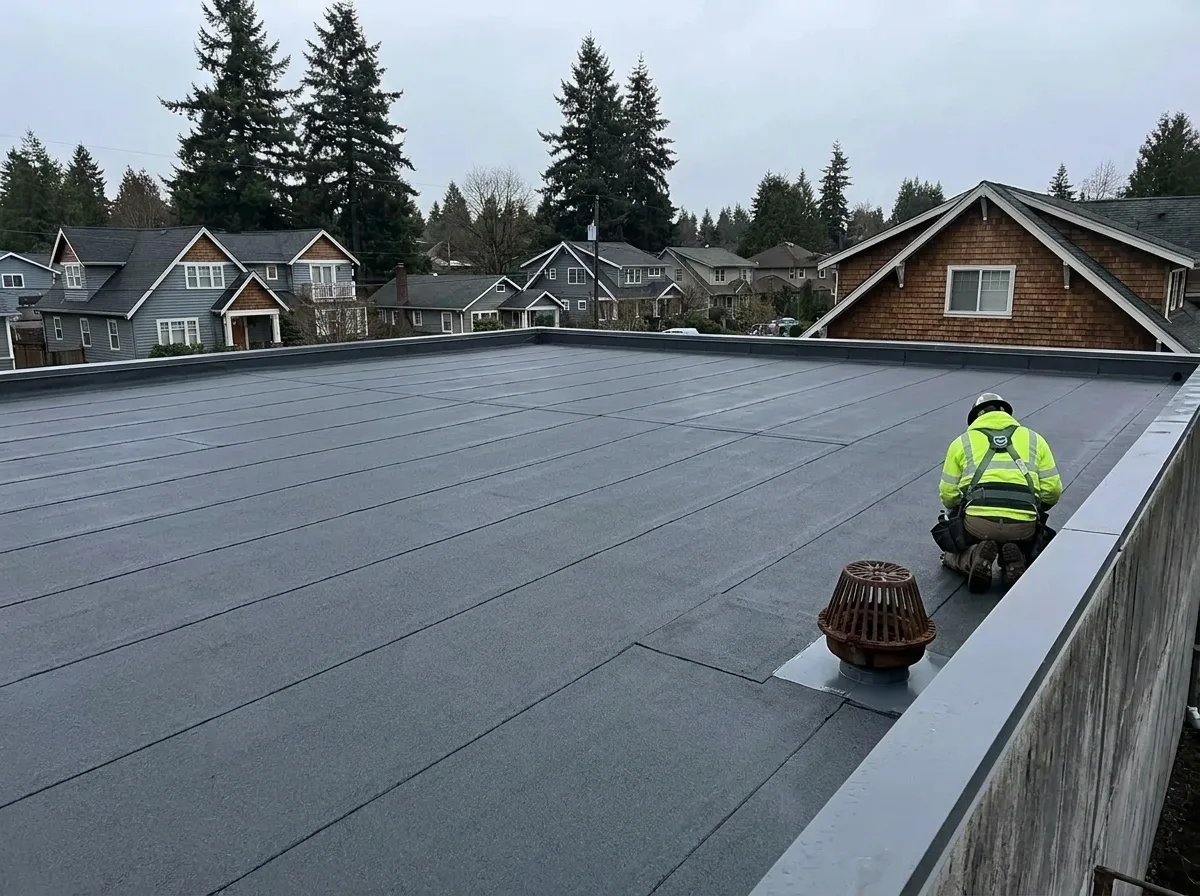
A failing low-slope membrane beside a new one. On flat roofs, drainage and detailing at penetrations decide how long the system lasts.
Photographs are illustrative of typical roof conditions in Greater Victoria and are not a record of work performed by Capital Roofing Victoria.
Questions, answered
Because they have no help from gravity. A pitched roof sheds water even where the detailing is imperfect, while a low-slope roof relies entirely on a continuous watertight membrane and working drains. Any defect is exposed to standing water rather than briefly wetted.
Service life depends far more on drainage and detailing than on the membrane brand. A roof that drains fully after rain and has sound flashings will reach its expected life. One with persistent ponding under Greater Victoria's heavy winter rainfall will fail early regardless of what was installed.
Water still standing more than a day or two after rain stops is a warning. It usually means a blocked or undersized drain, a deck that has deflected, or slope that was inadequate from the start. Standing water accelerates membrane degradation and loads the structure, so it is worth diagnosing rather than watching.
Yes, and it is common on additions, covered decks and modern residential designs. The transition is the critical detail, because a pitched roof concentrates a large volume of water onto a small area of membrane. That junction needs deliberate flashing and adequate capacity below it.
Sometimes, but only after checking what is underneath. If the insulation is saturated, if there are already multiple layers, or if the deck has deflected, an overlay traps the problem and the new roof underperforms. A core sample or opened test area answers the question properly.
Related work
Complete tear-off and replacement for roofs at the end of their service life. Every layer is inspected and rebuilt, not just the visible surface.
Investigation and repair of active or recurring roof leaks, tracing water intrusion back to where it genuinely enters the roof assembly.
Repairs, replacements and new roofing systems for commercial buildings, planned around occupancy, access and keeping the building operating.
Tell us your name, how to reach you and what the roof is doing. We will come and look at it, then put the scope, the materials and the labour in writing before anything begins.
Mon–Fri 7:00am–5:00pm · Saturday by appointment
Thank you — your enquiry has come through. We will be in touch to arrange a site visit and go over the details. If the situation is urgent, call us directly rather than waiting on a reply.
(778) 562-5640Ready when you are
Book a survey covering membrane condition, drainage performance and every penetration.