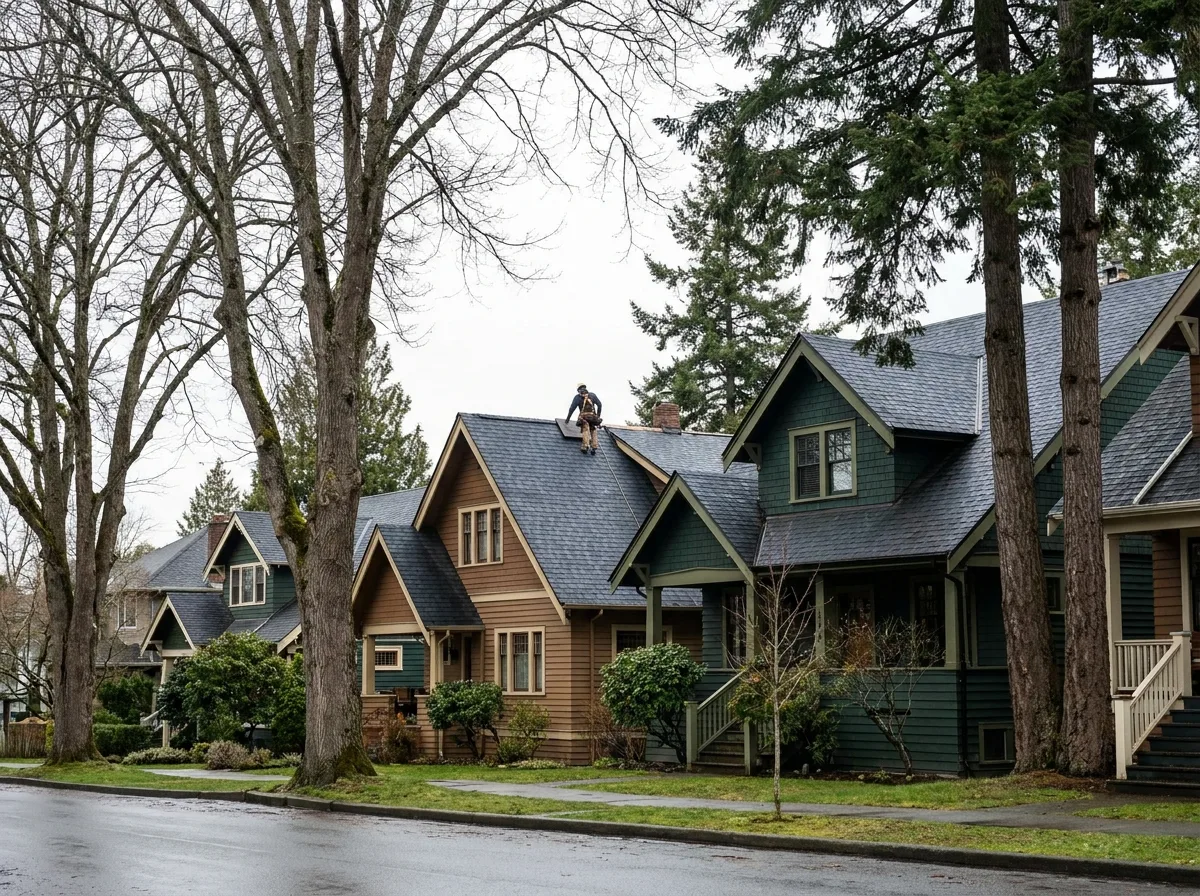
Roofing built for Victoria’s housing stock
Victoria is an old city by British Columbia standards, and its roofs show it. The core neighbourhoods — Fairfield, James Bay, Fernwood, Rockland, Oaklands — are dominated by houses built well before the Second World War, framed and sheathed to standards that have nothing in common with modern residential construction. Working on those roofs means expecting board decking, hand-cut framing, out-of-square planes and flashing details that were solved on site by whoever built the house.
What we find under Victoria roofs
The most common surprise on a tear-off here is the deck itself. Skip sheathing installed for cedar shakes leaves gaps that will not support an asphalt or metal system without new overlay. Boards split along the grain at fastener lines. Rot concentrates in the predictable places: around chimney curbs, at the base of dormer cheeks, in valleys that have been holding wet debris for decades, and along eaves where gutters have been overflowing.
We quote with those conditions accounted for. A free detailed quote from us itemises the scope, the materials and the work, including how deck repair is measured and handled, so the number you approve is the number you understand.
Steep, cut-up rooflines
A Rockland roof with cross-gables, dormers and a turret is not a larger version of a simple two-plane roof — it is a different job. Nearly all the risk sits in the transitions: valley construction, sidewall and headwall flashing, chimney counterflashing, and the tie-ins where an addition meets original framing. Those are the details we spend time on, because those are the details that leak.
Flat and low-slope in the core
Downtown and the Douglas–Blanshard corridor carry a heavy concentration of flat and low-slope roofs on commercial and mixed-use buildings. Those systems fail at seams, drains, parapet walls and mechanical penetrations rather than in the open field, and diagnosing them properly takes a different approach than a sloped residential roof.
Debris, moss and the wet season
Under a mature Garry oak or Douglas fir canopy, the roof is never really dry between October and April. Needles and leaves pack into valleys and gutters, hold water against the roof surface and give moss the foothold it needs. Regular clearing and honest maintenance extend the life of a roof here more reliably than any single product choice.
Capital Roofing Victoria is licensed and insured, and every crew is covered by WorkSafeBC. For an emergency leak, call, email or send the form and we will get back to you as quickly as we can.