Skip to content

Saanich, BC

Saanich Roofing and Roof Replacement

Saanich subdivisions built in the sixties, seventies and eighties are now on their second or third roof, and it shows.

Roofing in Saanich

Roof replacement, cedar shake conversion and moss control across Saanich, from Gordon Head and Broadmead to the coastal edges at Cordova Bay.

  • Subdivisions at second- and third-roof age

    Gordon Head, Broadmead and Royal Oak filled in through the 1960s, 70s and 80s, which puts a huge share of Saanich housing at the point where the original roof has already been replaced once and the replacement is now aging out. That generation of homes shares recognisable traits: wide eaves, moderate pitches, large uninterrupted planes and, very often, undersized attic ventilation.

  • Cedar shakes, converted and unconverted

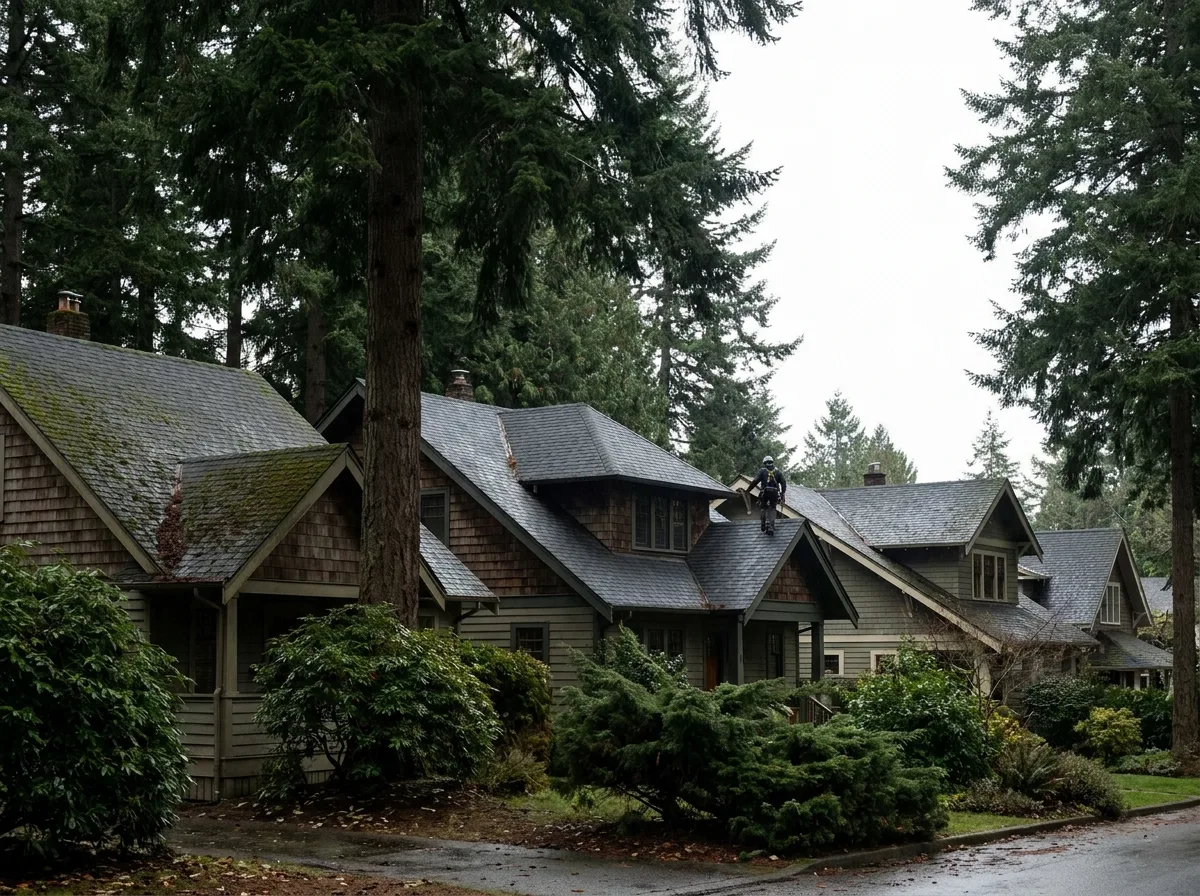
    A great many Saanich homes were roofed in cedar shake originally. Some have since been converted to asphalt or metal, and some are still running the original shakes decades past their service life. Converting a shake roof is not a straight swap — skip sheathing has to be overlaid, ventilation reassessed and the flashing details rebuilt for a continuous-surface system. Heavy Douglas fir and cedar cover on Saanich's larger lots also drops needles onto those roofs year-round, packing valleys and gutters and feeding moss on every shaded plane.

  • Coastal exposure at Cordova and Cadboro Bay

    The eastern shoreline neighbourhoods take direct wind off Haro Strait and the Gulf Islands, along with salt-carrying air the inland neighbourhoods never see. Ridge caps, edge metal, exposed fasteners and gutter hardware wear noticeably faster within a few blocks of the water than they do in Royal Oak or Tillicum.

Roofing across Saanich, from Tillicum to Cordova Bay

Saanich is the largest municipality in the region and the least uniform. A roof job in Tillicum and a roof job in Broadmead can have almost nothing in common — different decades of construction, different lot sizes, different tree cover, different exposure. The one thing most of it shares is age: an enormous share of Saanich housing has reached the point where the roof is the next major expense.

The subdivision generation

The postwar-through-eighties subdivisions that define Gordon Head, Broadmead and Royal Oak were built with generous eaves, moderate pitches and large open roof planes. They are straightforward roofs to work on, which is good news for cost, but they share two recurring weak points: attic ventilation that was undersized by current standards, and flashing details at chimneys, skylights and wall tie-ins that were done to the minimum of the day.

When we replace a roof of that vintage, ventilation and flashing get reassessed as part of the job. Reinstalling a new covering over an old ventilation problem simply moves the failure date.

Cedar shake and what conversion actually involves

Cedar was the default here for a long time, and plenty of it is still in place. A shake roof sits on skip sheathing — spaced boards that let the shakes breathe. Asphalt and most metal systems need a continuous deck, so conversion means overlaying the existing sheathing before anything else happens. The flashing, the ventilation and the edge details all get rebuilt at the same time. It is a bigger scope than a like-for-like replacement, and we itemise it so the difference is visible.

Trees, debris and moss

Saanich’s tree canopy is one of the best things about living here and one of the hardest things about maintaining a roof here. Fir and cedar needles pack into valleys, sit behind chimneys and fill gutters faster than most owners expect. Wet debris on a shaded plane is the beginning of every moss problem we deal with in this municipality.

The coastal edge

Cordova Bay and Cadboro Bay behave more like Sidney than like Royal Oak. Wind off the strait and salt in the air accelerate wear on edge metal, fasteners and gutter hardware, so those roofs get detailed with corrosion in mind.

Capital Roofing Victoria is licensed and insured, with WorkSafeBC coverage on every crew. For an emergency leak in Saanich, call, email or send the form and we will get back to you as quickly as we can.
Most requested here

What Saanich roofs need most

All services

Roof Replacement

Complete tear-off and replacement for roofs at the end of their service life. Every layer is inspected and rebuilt, not just the visible surface.

Scope is set after the roof is actually assessed, so the recommendation reflects the condition of your decking, flashing and ventilation rather than a standard package.

Explore this service

Roof Repair

Focused repairs to shingles, flashing, vents and roof penetrations that restore weather protection without replacing a roof that still has life in it.

Learn more

Cedar Shake Conversion

Replacing aging cedar shake roofing with a modern system, including the skip-sheathing and decking work these conversions almost always require.

Learn more

Gutter Installation

New gutter systems designed and installed to move roof water away from the building, sized for Greater Victoria's winter rainfall.

Learn more

Roof Ventilation

Assessment, installation and improvement of attic and roof ventilation so air moves through the assembly instead of condensing inside it.

Learn more

Moss Removal

Careful moss removal that protects roofing material while clearing the growth that shortens roof life on our damp north-facing slopes.

Learn more

Questions, answered

Roofing questions from Saanich

  • You can re-shake, or you can convert to an asphalt or metal system. Conversion is the more common choice because it changes the maintenance profile substantially, but it requires overlaying the skip sheathing with solid decking and rebuilding the flashings. We will quote both paths so you can compare the scope rather than just the headline number.

  • Considerably. Overhanging conifers drop needles year-round, and that debris is what holds moisture on the roof surface and in the valleys. On heavily treed Saanich lots the practical difference between a roof that reaches its expected service life and one that does not is usually maintenance frequency, not the shingle brand.

  • North-facing and shaded planes dry out far more slowly after rain, so moss establishes there first and grows thickest. Adding tree shade on that side compounds it. Treating the whole roof but only clearing debris from the sunny side is why the problem keeps coming back on the same slope.

  • Usually it is a ventilation problem, and it is common in homes of that era. Intake at the soffits and exhaust at the ridge need to be balanced; when they are not, you get heat buildup in summer and condensation on the underside of the sheathing in winter. We assess ventilation as part of a replacement rather than treating it as an add-on.

  • Yes, and we detail those roofs differently. Closer to the water we pay particular attention to edge metal, ridge and hip fastening, and any exposed hardware, because wind uplift and salt-laden air are the two things that shorten a roof's life there. Corrosion-resistant fasteners and flashing are worth the difference.

Ready when you are

Book a free roof assessment in Saanich

We will walk the roof, document what we find and itemise the work in writing.